What a Visualisation Brief Should Actually Contain: A Developer's Checklist
Most developers walk into an architectural visualisation project with a floor plan, a deadline, and the assumption that the studio will figure out the rest. They rarely do, at least not cheaply. The gaps between what was assumed and what was actually briefed show up later as revision rounds, misaligned assets, and campaigns built around renders that never quite fit the story they were supposed to tell.
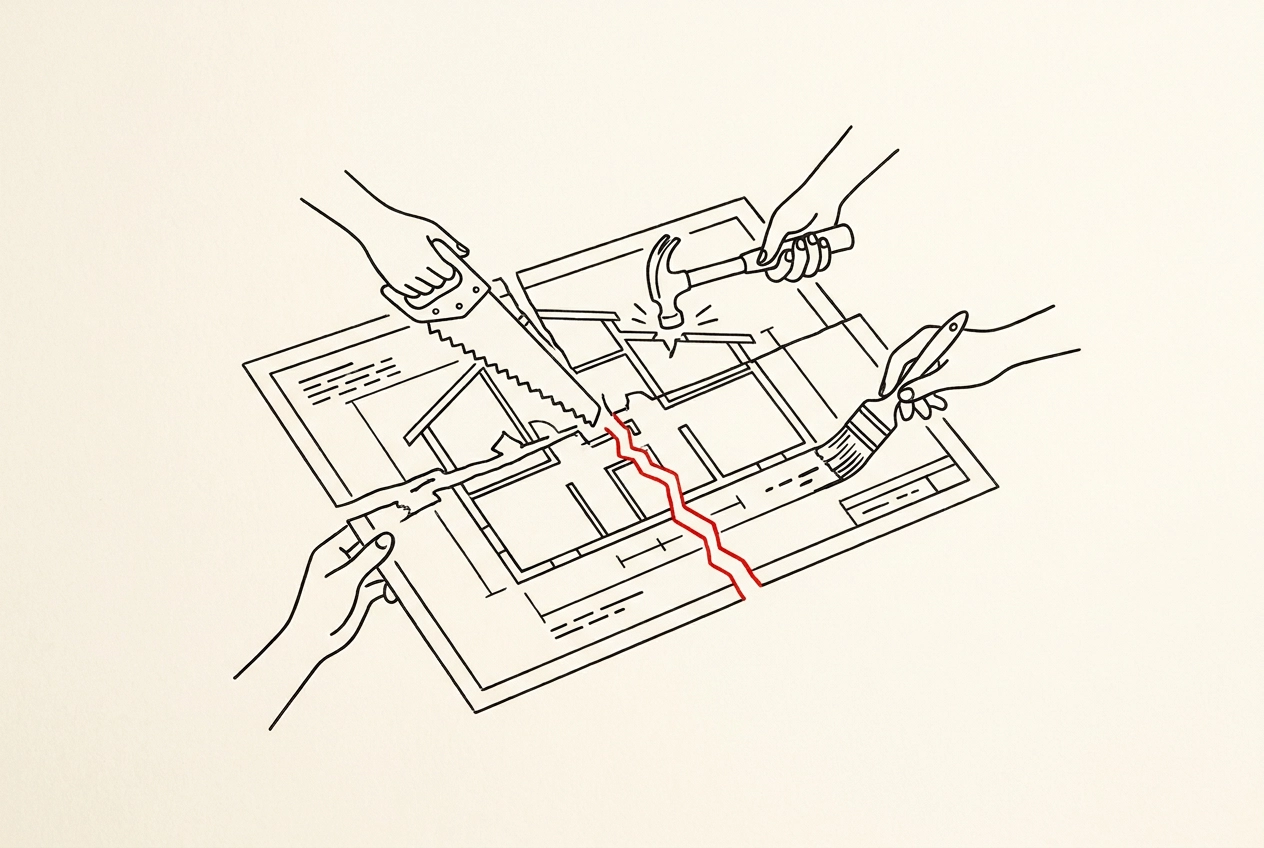
A well-constructed brief is not an administrative formality. It is the document that controls interpretation before production begins, and every decision left out of it gets made by someone else, usually at your expense.
This post defines exactly what a complete brief contains. You will find a structured checklist covering campaign context, buyer persona, technical inputs, material intent, visual direction, deliverables, approval process, and scheduling. Each section addresses a category where under-briefed projects typically lose time or money. Whether you are preparing your first brief or refining a process that has been producing inconsistent results, the framework here gives you a clear standard to work from.
Why Most Briefs Fall Short Before Production Even Starts
Hand a studio a floor plan and a deadline, and you have given them just enough to start in the wrong direction.
This is the industry norm and the primary reason revision cycles blow out before a single render reaches approval. The problem is rarely the rendering process itself; it is everything left undefined before production started.
Incomplete briefs force studios to interpret. Every unanswered question about materials, buyer audience, or campaign context becomes a decision the studio makes on your behalf, sometimes correctly, rarely without cost. When those interpretations miss, revision rounds consume exactly the time and budget the brief was supposed to protect.
In practice, most delays trace back to three sources: missing decisions, unclear stakeholders, and late-stage changes that could have been locked in at briefing. These are not production failures. They are briefing failures.
A well-formed brief functions as a decision-control document. It closes off interpretation before time and money are spent on the wrong version. Think of it less as a request form and more as the document where project control actually lives. If you have questions about what inputs a studio needs to get started, our FAQ covers the essentials in plain terms.
Time invested sharpening a brief before production begins consistently returns more than it costs, in fewer revision rounds and faster sign-off.
Campaign Context: Where the Project Sits in the Sales Story

The first thing campaign context establishes is project stage, and this single decision shapes everything that follows. Renders produced for investor confidence carry a different visual register than assets built for a display suite opening or a planning submission. Each stage has its own audience, its own emotional stakes, and its own tolerance for design ambiguity.
Beyond stage, the brief needs to confirm whether assets sit within a broader campaign covering print, digital, social, animation, and wayfinding, or whether they are standalone deliverables. That distinction changes every compositional decision. An image destined for a display suite wall, a billboard, and an Instagram Story simultaneously cannot be framed for just one context without compromising the others.
Channel requirements belong in the brief explicitly: billboard, EDM, hoarding, display suite lightbox, and social formats each carry different resolution and aspect ratio demands. Requesting multi-format outputs at the start allows compositions to be built for all channels at once, eliminating rework later. You can see how this thinking flows through considered campaign work.
Finally, anchor the brief to real milestones. A media booking deadline, a display suite opening, a planning submission date: these hard constraints determine how a studio sequences its work. Studios providing holistic visualisation and campaign services can only align workstreams properly when that context is established from the outset.

Buyer Persona: Who the Images Are Actually Talking To
Once campaign context is locked, the next question is sharper: who are these images actually for?
A buyer persona is not a demographic checkbox. It is the interpretive lens that governs every material selection, lighting scenario, and camera angle the studio makes. Without it, those decisions default to generic, and generic does not sell.
A downsizer and a first-home buyer looking at the same apartment need to see fundamentally different things. Render that apartment with layered textures, warm evening light, and considered art styling, and it reads as a considered, quality-of-life upgrade. Strip it back to a cooler, cleaner palette with sharper lines, and the value proposition shifts entirely. Same geometry, different persuasion.
Your brief should articulate lifestyle signals: does the target buyer gravitate toward warm, tactile interiors or cool, minimal spaces? Is outdoor connection the draw, or urban immediacy? Is this a quiet retreat or an active social address?
Share whatever research the developer or selling agent holds on the cohort: comparable projects the buyer admires, publications they read, price sensitivity context. This audience intelligence is what allows a holistic visualisation approach to translate human insight into specific technical decisions, furniture selection, styling density, time of day, seasonal light, turning 3D architectural visualisation from documentation into persuasion.
Technical Inputs: The Files That Make Accurate Geometry Possible

Once the persona is defined, the geometry has to be right before any of that thinking can translate into a render. This is where briefs most commonly go thin.
Minimum technical inputs required for an accurate quote and a prompt start:
CAD drawings in .DWG format, including floor plans, elevations, and site plans
A site context package: surveyor's site plan, surrounding building heights, north point, and any known overshadowing constraints
If existing 3D models exist, provide them regardless of how complete they are. Revit (.RVT), SketchUp (.SKP), and Rhino (.3DM) files all reduce modelling time meaningfully, even at early stages. A half-built Revit model is still faster to work from than a flat plan. Don't hold them back waiting for the model to be "ready."
Be explicit about documentation maturity. A design development set requires substantially more interpretive work from a studio than a DA-approved or construction-issue set. That interpretation carries cost and risk; naming the stage removes both ambiguities upfront.
Finally, flag any design changes still in motion. A studio that knows where the live edges are can sequence geometry builds strategically rather than completing work that immediately needs to be redone.
Material Intent: Specifying Finishes Before the Studio Has to Guess
Accurate geometry gets the structure right. Materials get the project right.
Material ambiguity is one of the most reliable drivers of revision rounds. A studio should not be choosing between a warm oak and a cool ash on a kitchen joinery package because the brief left it open. That decision has downstream consequences across the entire scene.
Where selections are confirmed, provide them explicitly: cladding systems, window and door frames, flooring, joinery finishes, tapware, and soft furnishings. Product names, supplier references, and finish codes remove interpretation from the process entirely.
Where selections are pending, define the intent. "Warm, textured, natural palette" gives a studio enough to build a coherent placeholder. Silence does not. If you are working through questions for a visualisation brief with your team, material intent belongs near the top of that list.
Reference imagery strengthens this, but choose carefully. Pinterest mood boards signal a mood; they rarely communicate price point or brand position accurately. Specific references from comparable projects, like the finish language used in this visualisation work for Tim Spicer Architects, give a studio something calibrated to work from.
Material decisions also govern lighting. A dark, matte interior reads entirely differently under warm evening light than cool midday light, and both cannot coexist in the same scene. Defining materials early means lighting decisions can follow logically, rather than being revisited after renders are already in progress.
Visual Direction: Giving the Studio a Creative Anchor
Material intent defines what the finishes are. Visual direction defines how the images should feel. The two are related but distinct, and conflating them is a common briefing gap.
Specify the time of day, season, and weather conditions for every exterior view. A dusk render with warm interior light spilling across a terrace signals aspiration and liveability. A bright midday elevation study signals accuracy and documentation. Both are valid; they are just not interchangeable, and the choice should be deliberate.
For interiors, define the staging intent according to your buyer. Owner-occupier renders benefit from a lived-in, curated quality: books on the shelf, a half-read magazine, a considered layer of personality. Investor-focused renders typically read better as cleaner, more neutral spaces that let the buyer project their own tenant in. Neither approach is universally right; the persona drives the call.
Reference imagery is one of the most useful inputs a studio can receive. Share projects, photographers, or architectural publications that capture the emotional register you are after. Be specific rather than aspirational.
Finally, if a brand identity or campaign creative direction already exists, share the guidelines. Visualisation that runs parallel to a brand rather than through it produces assets that feel disconnected, however technically accomplished they are.
Deliverables and Output Formats: Specifying Assets, Not Just Views
Once visual direction is locked, the next question is equally concrete: what, exactly, is being delivered?
List every required asset explicitly in your brief. Not "some renders and a video" but: four exterior stills, three interior stills, one aerial, a 90-second animated walkthrough, and two vertical-format social clips. Vague scope is where scope creep originates.
Then specify output requirements for each asset individually. As a working guide:
Print (billboard, brochure cover, hoarding): standard practice calls for high resolution at final output dimensions; confirm exact DPI requirements with your print supplier, as a 3m x 6m billboard requires a substantially larger source file than an A4 brochure page
Display suite lightboxes and digital screens: native screen resolution at the correct aspect ratio; confirm specifications directly with your fitout supplier
Social media: confirm current platform requirements with your digital team, as aspect ratio specifications change regularly across formats and placements
Website headers: typically 16:9, but confirm with your web developer
If assets need to serve multiple channels, request cross-format delivery upfront. A studio can frame compositions to work across ratios from the outset; cropping after the fact almost always loses something.
For animations, define duration, resolution (4K or 1080p), and delivery codec. Confirm resolution and codec requirements with your studio and fitout supplier at brief stage, as encoding decisions are made at render stage, not after.
Approval Process: Naming Who Decides and When
Once deliverables are locked, most briefs go quiet on one critical question: who actually approves them?
This silence is where budgets erode. Defining the approval process upfront is not administrative formality; it is direct cost protection.
Name one decision-maker for each approval category. Who has final sign-off on creative direction? Who confirms materials? Who approves finished deliverables? When multiple stakeholders provide conflicting feedback without a clear hierarchy, revision cycles multiply fast. Consolidated feedback from a single nominated contact is a non-negotiable discipline.
Define revision rounds and scope boundaries explicitly. Specify how many revision rounds are included per deliverable type, and draw a hard line between a revision and a new scope item. Without a formalised distinction, scope boundaries blur, a common source of budget overrun in visualisation engagements. Changing a material finish within an approved brief is a revision. Introducing a new camera angle or redesigning the floor plan is new scope.
Set turnaround expectations on both sides. How quickly will the developer's team provide consolidated feedback? What is the studio's committed response time? Both commitments belong in the brief.
Finally, consider having all parties sign off on the brief before production begins. A formalised brief functions as a contractual reference document, protecting the developer and studio equally from scope drift and costly late-stage redesigns.
Schedule and Milestones: Working Backwards From What Matters
Once the approval framework is in place, schedule becomes the next place a brief either holds or unravels.
Start with the fixed points: display suite opening, media booking deadline, planning submission, or sales launch. Every milestone works backwards from those dates, not forward from when production can conveniently begin.
Prioritise deliverables by dependency, not urgency. Hero exterior renders typically gate everything downstream: brochure design, website builds, hoarding installation, and EDM templates cannot be finalised without them. Treating all assets as simultaneously required creates a false urgency that compresses the wrong stages.
Name review windows as milestones. A 48-hour turnaround expectation on both sides should appear explicitly in the schedule, not be assumed. Feedback delays compound quickly across multiple workstreams, and unscheduled review time is one of the most consistent sources of avoidable slippage.
Declare known bottlenecks upfront. If interior selections are still pending, or if the architect is mid-design development, the studio needs to know before production begins. This context allows geometry to be sequenced intelligently rather than rebuilt. You can read more about how this informs our process.
For campaigns spanning visualisation, animation, print, digital, social, and wayfinding, milestone alignment is not optional. Each workstream feeds the next, and a delay in one ripples across all of them.
The Brief as a Campaign Document, Not Just a Render Order
Milestones keep production moving, but it is the brief itself that determines whether the outputs, once delivered, add up to something coherent.
When visualisation, animation, print, digital, social, and wayfinding are briefed together from the start, each discipline informs the next. Camera angles established for hero renders frame the logic for animation sequences. Colour grading locked early carries through to printed collateral and digital display. Briefed together, these outputs compound rather than merely coexist.
That translates materially: faster pre-leasing, more confident investor decisions, stronger marketing ROI. The brief is not administrative paperwork; it is a financial lever, and the point at which project control is either established or surrendered.
Studios with genuine experience across 3D architectural visualisation, creative direction, and full campaign delivery are best placed to help developers build a brief at this level, because they understand precisely how each upstream decision shapes every downstream output.
Start With the Brief, Protect the Budget
So here is the full checklist. A complete brief covers campaign context, buyer persona, technical inputs, material intent, visual direction, deliverables, output formats, approval process, and schedule. Where any element is absent, the studio fills the gap, sometimes correctly, always at a cost.
Run this checklist before your next brief goes out. Share it with your selling agent and architect. Revisit it whenever design or campaign changes occur mid-production.
If you are unsure where your brief has gaps, a good studio will surface them in a briefing conversation before production starts. That conversation costs nothing and routinely saves weeks.
The brief is where project control actually lives. It is not administrative overhead; it is the earliest and most cost-effective investment a developer makes on any campaign. Organisational factors, including undefined scope and absent decision frameworks, are the primary driver of project failure in complex builds. The brief addresses exactly that, before a single asset is commissioned.
Conclusion
A strong brief is not paperwork. It is the document that determines whether your campaign delivers on time, on budget, and on brief.
The checklist above covers every category where under-briefed projects lose time or money, run yours against it before production starts.
The studios that produce the strongest work are not given more budget. They are given better briefs. Start there.