Display Suite Design for Off-the-Plan Apartments: What Developers Need to Commission Before They Build Anything
Most developers commission a display suite the same way they commission a kitchen renovation: pick a builder, specify some finishes, and assume the result will sell apartments. It will not. The off-the-plan sales environment in 2026 demands something fundamentally more sophisticated, and developers who miss this are paying for it in slower sales velocities and buyers who walk out unconvinced.
Effective showroom design is not decoration. It is a conversion instrument that must simultaneously communicate price point, lifestyle aspiration, and brand trust to a buyer who cannot yet see the real thing. When that instrument is briefed in isolation from your CGIs, signage, and digital sales tools, the buyer experience fractures at exactly the moment it needs to be seamless.
This analysis is written for developers, not designers. It covers what your display suite must achieve commercially before a single material board is specified, why siloed commissioning is measurably damaging your results, and how to structure a holistic brief that aligns every physical and digital touchpoint. Getting this right before you engage any contractor is the highest-leverage decision you will make in the entire sales program.
The Fundamental Misunderstanding Most Developers Start With

Most developers brief a display suite the way they would brief a display home: select the finishes, appoint a stylist, make it look aspirational. The assumption is that the suite's job is to show what the apartment will look, feel, and smell like. That assumption is commercially costly.
A display suite is not a dressed apartment. It is the primary conversion instrument for a product the buyer cannot yet physically inspect, walk through, or verify with their own senses. Before we begin with any spatial brief, that distinction needs to be settled, because everything that follows depends on it.
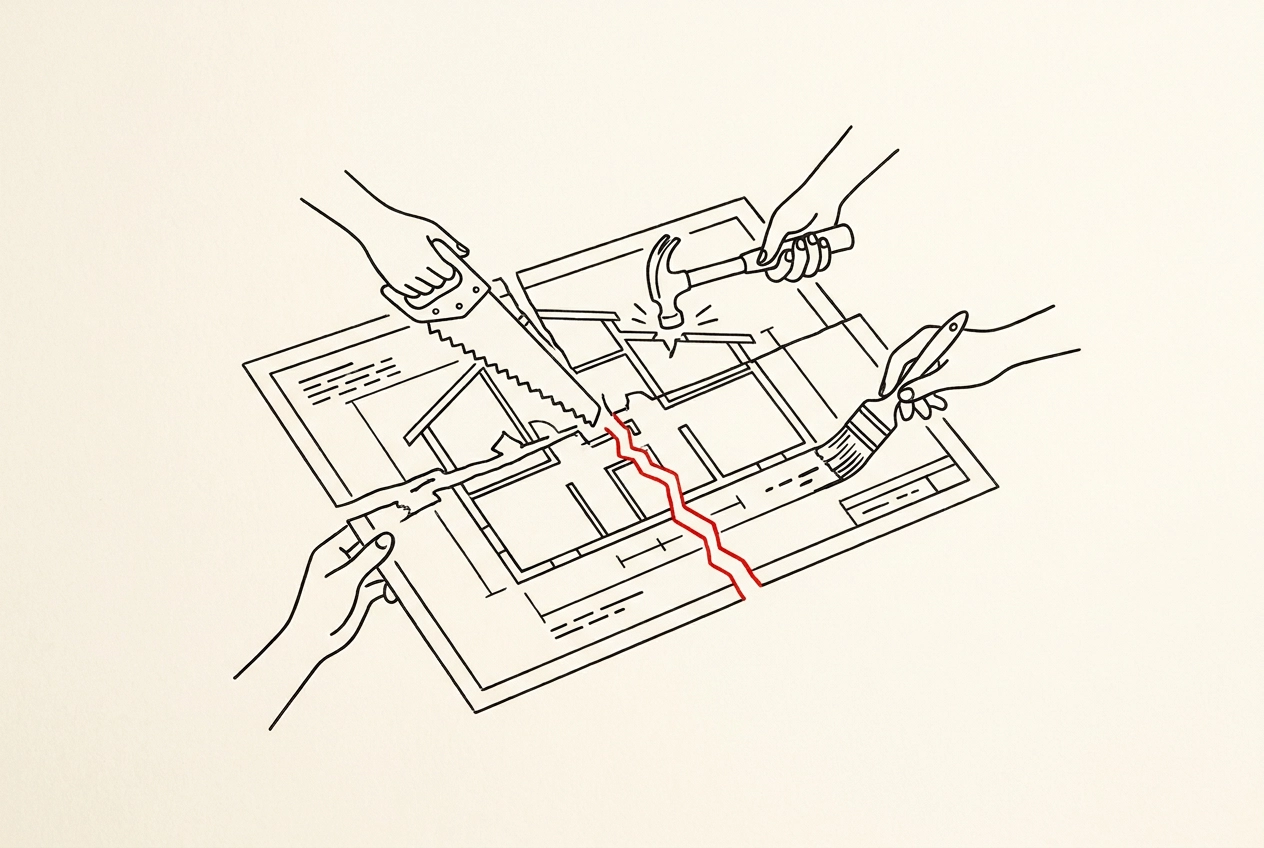
When the display suite brief is written in isolation from the CGI campaign, signage, and sales collateral, the buyer experiences the seams. A warm, earthy render palette on the project website. A corporate typeface on the hoarding. A cool, stylist-led interior scheme in the suite itself. Separately, each decision is defensible. Together, they communicate a brand that has not resolved its own identity, and buyers feel that uncertainty before they can articulate it.
The cost is not abstract. Misalignment produces slower sales velocity, a higher volume of buyer objections during the sales process, and a sales team spending meeting time manually bridging gaps that the environment should be closing automatically.
The stakes are higher now because the buyer demographic has shifted. Owner-occupiers represent a growing and commercially decisive purchaser segment in most residential off-the-plan markets. Unlike investors, they cannot be closed on yield projections and depreciation schedules. They need to be educated: to understand what they are buying, to feel the lifestyle it represents, and to trust the developer delivering it. A display suite that functions as a showroom design concept rather than a lifestyle education tool fails this cohort entirely.
The highest-leverage decision in a project's marketing is not which stone to specify for the kitchen bench. It is whether the brief governing every marketing touchpoint was written as one integrated document, before any contractor was appointed.
What Off-the-Plan Buyers Actually Need in 2026
Understanding who is actually sitting across from your sales consultant changes everything about how the display suite should be briefed.
Owner-occupiers behave entirely differently from the investors who once drove pre-launch velocity, as established above. Building on that contrast: what this segment requires is not a pitch but an education. The engagement depth the suite must achieve, and the confidence it must build, are the commercially decisive variables.
These buyers are not evaluating yield or depreciation schedules. They are asking whether they can picture their life in this building, on this street, in this apartment. That is an emotional and experiential evaluation, and it requires a fundamentally different sales environment to support it.
Static renders do not close that gap. They establish interest, but they do not build the kind of confidence that produces a signature. Buyers need to visualise their future home in its entirety; they need to understand scale, materiality, light, and sequence before they can commit to something they cannot yet walk through. Collateral that only shows the best angle of the best apartment is not education. It is advertising, and buyers have become sophisticated enough to know the difference.
The engagement data bears this out. Developments using immersive display environments have seen average buyer meeting durations extend from roughly 30 minutes to 90 minutes. That tripling is not incidental. It reflects buyers who are being genuinely educated rather than processed, and it is a far more meaningful metric than raw lead volume.
Confidence is cumulative, and it is fragile. It builds across every touchpoint: the CGI campaign that first caught the buyer's attention, the digital experience before they visit, the physical display suite on arrival, and the collateral they take home. A disconnection between any of these is felt before it is understood. The buyer cannot always articulate why they feel uncertain; they simply do.
Developers who orient their brief around what the buyer needs to feel and understand, rather than what is simplest to deliver, consistently see it reflected where it counts: in pre-launch sales results.
The Display Suite Is a Conversion Instrument, Not a Decorated Room
That shift in buyer behaviour makes one thing clear: the display suite is the moment all prior engagement is either validated or undermined. What it communicates in those first minutes determines whether a buyer moves forward or retreats to uncertainty.
A display suite must do three things simultaneously, and without contradiction: communicate price point, establish lifestyle aspiration, and build brand trust. These are not aesthetic decisions. They are strategic ones that must be resolved before a single material is specified or a builder is briefed.
Price point is communicated through precision, not luxury. Material quality, spatial proportion, joinery tolerances, the weight of a door handle; every detail registers subconsciously against the number on the sales sheet. Buyers cannot always articulate the mismatch, but they feel it. A display suite where the finish level undershoots the pricing creates doubt that the sales consultant then has to work twice as hard to overcome.
Lifestyle aspiration is not purchased with expensive furniture. It is built through coherence. A showroom design that feels curated from a single point of authorship, where every surface, object, and printed piece reinforces the same story, communicates that the developer has genuinely resolved their product positioning. A suite that feels assembled from separate decisions signals the opposite: that no one was responsible for the whole.
Brand trust is the most fragile of the three, and the easiest to accidentally destroy. If the project logo on the wall uses a different typographic weight than the brochure on the table, buyers register the inconsistency. If the display suite palette bears no relationship to the CGI campaign they encountered online, the spatial experience feels like a different product. These are not finishes problems. They are briefing problems.
Recognising the display suite as a conversion instrument, rather than a dressed room, changes who needs to be in the brief. The interior direction and the visualisation work are not parallel appointments; they are the same conversation. Run by one of your own, a studio that holds both disciplines under one brief eliminates the gaps that siloed commissioning reliably produces.
Why Siloed Commissioning Breaks the Buyer Experience
Knowing that the display suite must earn trust, communicate price point, and sell a lifestyle simultaneously makes the next question urgent: who is actually coordinating all of that? In most off-the-plan campaigns, the honest answer is nobody.
The most common structural failure is sequential commissioning. CGI is briefed first, often months ahead of everything else. Signage goes to a separate studio with a separate brief. The display suite builder is engaged later, with documentation that references neither. Sales tools are produced at the end by whoever has availability. Each appointment feels rational in isolation. Together, they produce a buyer experience that is fractured at every seam.
The incoherence is not obvious to the vendors producing it. The visualisation studio selects a warm, earthy palette that suits the project's residential character. The signage studio defaults to a corporate sans-serif because it reads cleanly at scale. The display suite stylist introduces a cool-tone scheme because it photographs well under artificial light. Every decision is defensible on its own terms. The buyer, however, experiences all three as a single brand, and registers the dissonance without necessarily being able to name it.
That dissonance carries a specific commercial cost. A misaligned showroom design does not just look inconsistent; it communicates organisational uncertainty to someone who is about to make one of the largest financial commitments of their life. Uncertainty is the enemy of conversion.
The financial damage compounds across the campaign: additional sales meetings required to manually rebuild the confidence the environment should have generated, collateral budgets spent on materials that contradict each other, and in worse cases, project repositioning mid-campaign when early sales velocity signals that something is structurally wrong with the buyer experience.
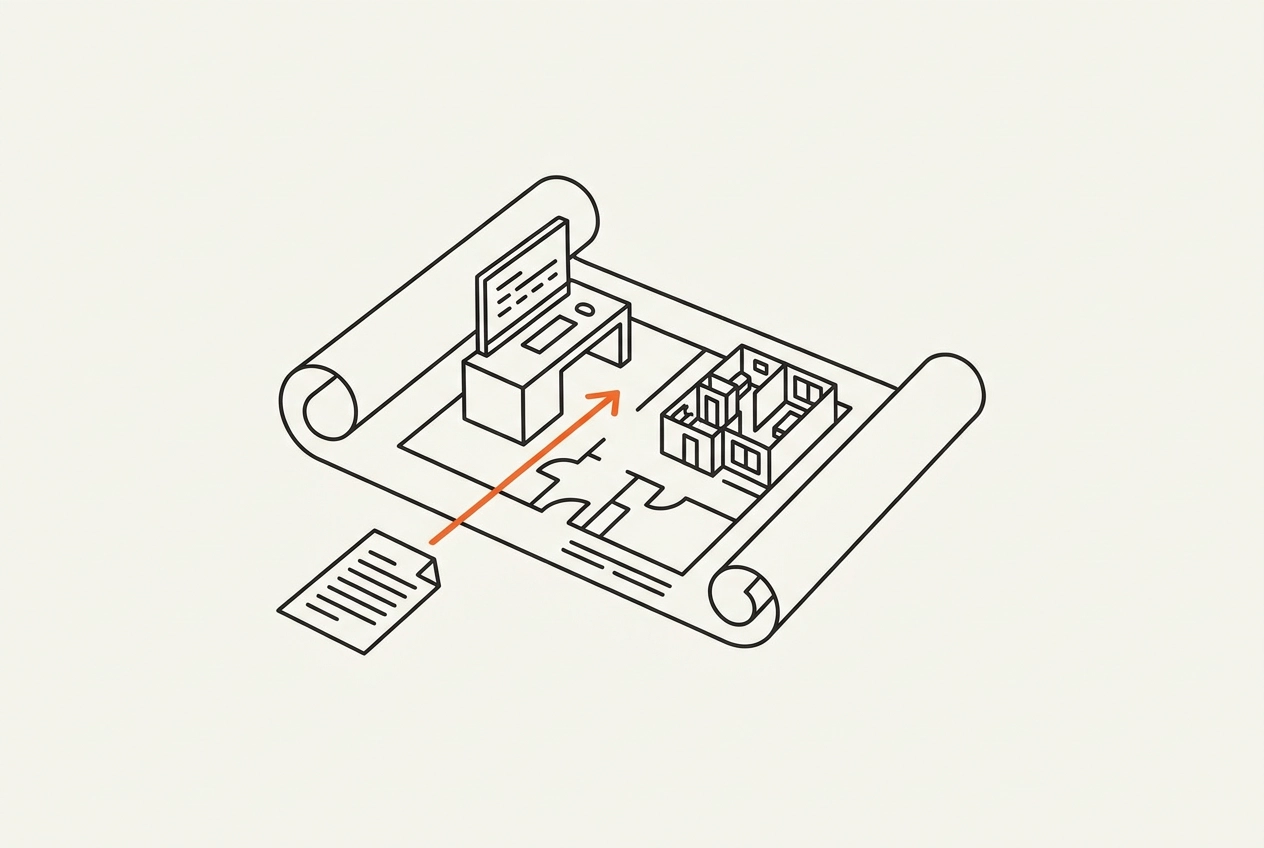
The solution is not consolidating all work into a single vendor. It is ensuring that a single brief, written before any appointment is made, defines the creative and commercial parameters every party must work within. That brief is the only reliable integration mechanism available to a developer working with multiple specialists.
What the Brief Must Resolve Before Any Contractor Is Engaged
So the brief is the integration mechanism. What it actually contains determines whether that mechanism works.
The buyer persona comes first, and it must go further than a demographic profile. Age range and income bracket tell you nothing useful at briefing stage. What matters is a clearly articulated portrait of what this buyer is moving toward: the life stage, the specific aspiration, and, critically, the anxieties particular to an off-the-plan purchase. Construction timelines, specification changes, valuation risk at settlement. Every spatial and material decision in the display suite should be checkable against this portrait. If it cannot be justified by what the buyer needs to feel and understand, it has no place in the brief.
The price point narrative follows directly. What does value look like, at this price, for this buyer, in this location? The display suite design concept must be calibrated to that answer, not to the developer's personal taste or the designer's portfolio work. A finish level that reads as understated sophistication at $1.4 million reads as budget compromise at $900,000. The spatial environment has to tell a price-honest story.
The brand and visual identity system should be resolved, or at minimum directionally locked, before the display suite builder is engaged. Typography, palette, texture language, graphic tone. The physical space is an extension of the brand; it cannot be a parallel interpretation developed in isolation. What architectural visualisation contributes to this alignment is substantial, because the CGI campaign and the spatial environment need to speak from the same visual foundation.
The digital and physical integration map asks a simple but rarely answered question: where does the buyer's journey begin, and how does the display suite continue that narrative rather than restart it? A buyer who arrived via paid social, explored the project website, and viewed renders has already formed impressions. The suite must go deeper, not repeat.
The content production mandate is a brief decision with long campaign consequences. The suite will be photographed and filmed. Lighting, sightlines, and set-dressing logic must be considered as a content production environment from the outset, not retrofitted after construction.
The sales tool ecosystem closes the loop. Brochures, specification sheets, and follow-up materials used during and after the visit must be designed as spatial extensions, not standalone documents briefed separately at the end.
Physical and Digital: The Integration Imperative for Modern Showroom Design
Once the brief parameters are locked, the question becomes execution: how the physical and digital dimensions of the display suite are made to function as one environment rather than two parallel workstreams that happen to share a postcode.
The contemporary display suite is a hybrid instrument. It is part physical showroom, part interactive exploration platform, and increasingly part content production environment. Treating these as separate commissions, briefed in sequence to different parties, produces visible seams in the buyer experience. Buyers feel those seams before they can name them.
Interactive 3D tools have materially changed what buyers expect when they arrive. Building on the engagement extension documented earlier, projects like Sanctuary Mount Pleasant recorded 30 per cent of apartments sold before official launch, with buyer confidence attributed directly to interactive digital exploration. The ability to navigate floor plans, compare finish schemes in real time, and view outlook from a specific floor level transforms the sales conversation from a presentation into an education. These tools are no longer supplementary; for owner-occupiers making a decision of this scale, they are often what tips the commitment.
The spatial design of the showroom must be planned around how those tools are deployed within it. Screen placement, ambient lighting, seating orientation, and sightlines all determine whether a buyer feels guided or processed. A suite designed without this consideration tends to read as a sales kiosk regardless of the finish quality, and that registers as a mismatch with the price point.
The physical and digital layers must also be sequenced correctly for buyers who have already engaged online. A buyer arriving after exploring the project digitally needs to go deeper in the suite, not repeat the same information. The physical environment should reward prior engagement, not ignore it.
Finally, the suite itself generates the content that drives future buyer visits. Photography, video walkthroughs, and 360-degree captures all originate in that space. Developers who design with this content loop in mind, considering sightlines and lighting as production decisions alongside spatial ones, extract significantly more marketing value from a budget that was always going to be spent.
Signage, Wayfinding, and the Off-Site Brand Experience
The physical display suite experience does not begin at the front door. It begins the moment a buyer encounters the project in the built environment: a hoarding at the construction boundary, a directional sign at the street corner, a banner at the sales office entrance. These are the first tangible, three-dimensional expressions of the brand, and they establish an expectation that everything inside the suite must meet or exceed.
When that signage has been briefed separately from the display suite creative direction, the gap registers immediately. A buyer who has spent six weeks engaging with a refined digital campaign arrives to find hoarding graphics using a different typographic weight, or wayfinding panels in a material finish that has no relationship to the interior palette. They may not articulate what feels wrong. They feel it as a step down, a loosening of quality, before they have seen a single material sample. In a prestige development where the buyer's price sensitivity to perceived value is acute, that tonal inconsistency can undermine weeks of carefully built confidence.
Wayfinding within and around the display suite carries the same weight. Directional hierarchy, the finish of a sign mounting system, the consistency of type across every printed and fabricated surface: these details communicate organisational care to a buyer who is reading every available signal. Signage that has been applied to walls after the fact, with no relationship to the spatial brief, reads as exactly that. It does not read as effortless; it reads as an afterthought.
The integration of signage and wayfinding into the showroom design concept is one of the most consistently overlooked opportunities in developer marketing. Resolved holistically within a single brief, it is invisible in the best sense. Fragmented across separate vendor appointments, it is conspicuous in the worst sense.
A studio directing both the spatial environment and the signage system from one integrated brief eliminates this fragmentation before it forms.
The Display Suite as a Content Generation Engine
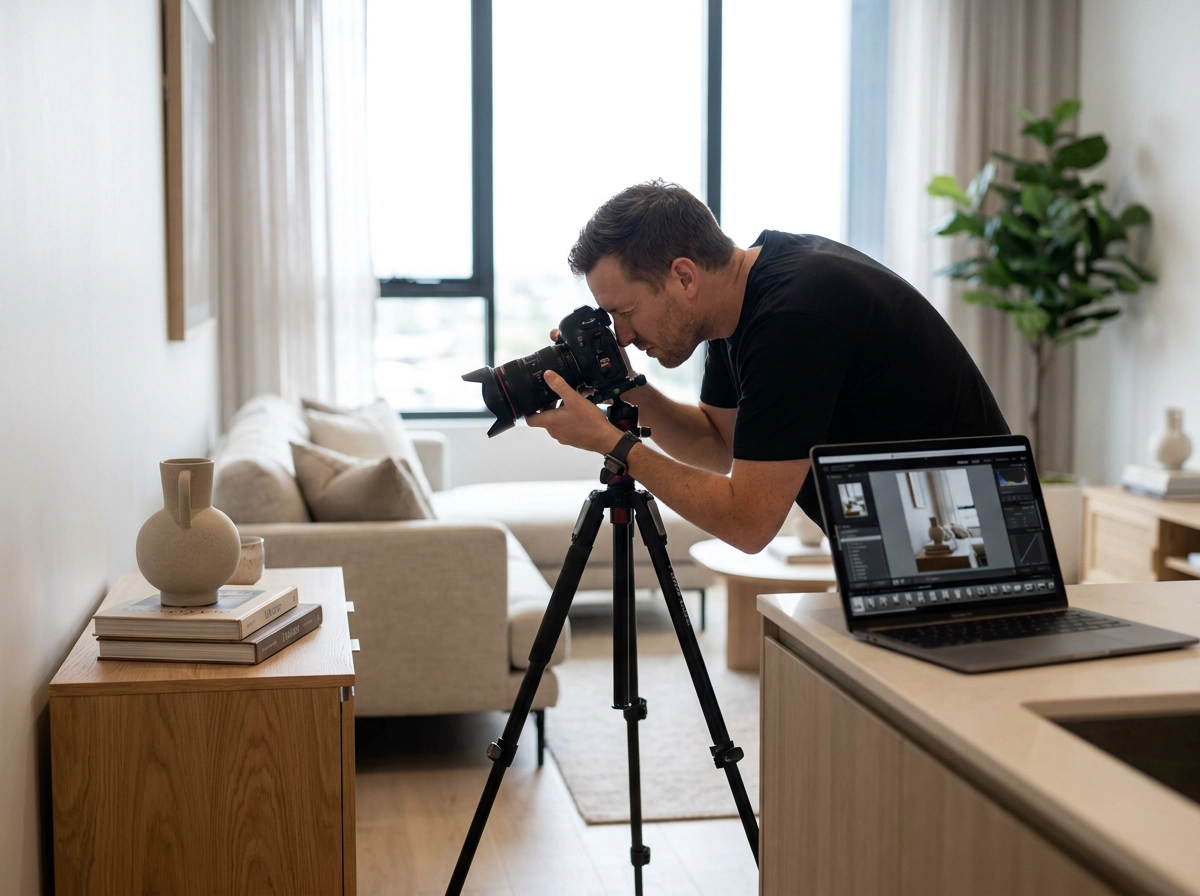
The same logic that applies to signage continuity applies here, but the stakes compound. A display suite is not only a place buyers visit; it is the production environment that generates the content driving those visits in the first place. Photography, video, 360-degree captures, lifestyle imagery, all of it originates in the physical space and feeds directly into the digital campaigns that keep the sales pipeline moving.
Developers who recognise this from the outset of the brief extract significantly more value from their production budget. Sightlines, natural light, and set-dressing logic are spatial decisions with direct content consequences. A suite with poorly considered sightlines, insufficient natural light, or styling that serves the in-person visit but photographs flatly will constrain every downstream content decision. Those constraints cannot be fixed in post-production.
For off-the-plan projects, social media engagement is disproportionately driven by content that communicates lifestyle aspiration rather than product specification. Buyers do not share floor plan dimensions; they share the feeling of a Sunday morning in a kitchen that looks exactly like the life they are moving toward. The display suite is the primary source of that content. A brief that does not explicitly account for social content production leaves that channel chronically underpowered relative to its potential.
360-degree imagery and interactive walkthrough content generated from the suite extend the sales environment into digital channels, allowing interstate and international buyers to engage at genuine depth without a physical visit. This is not a supplementary consideration; for developers with significant purchaser segments outside their home market, it is a core sales infrastructure question.
How to Structure a Holistic Display Suite Brief
All of that content work, at the brief stage and before, means nothing if the document governing it is structured backwards. Most developer briefs open with mood boards and material references. The commercial parameters, if they appear at all, are buried somewhere near the end.
Reverse that order entirely.
The first page of the brief states the sales target, the target buyer, the price point, and the campaign timeline. Every creative decision that follows is tested against those parameters, not against personal preference or portfolio precedent. Aesthetic aspiration earns its place by serving commercial outcomes, or it does not belong in the document.
From there, define the integration touchpoints explicitly. Specify which display suite elements must directly reference the CGI campaign, whether palette, material language, or lifestyle positioning. Specify which must align with the signage system. Specify which must support the sales tools the consultant uses during a buyer meeting. Leaving these connections implicit is how coherent individual decisions become an incoherent buyer experience.
Content deliverables, covered in the production mandate above, must be reviewed before construction documentation is issued.
The question of creative authority deserves its own page. If the CGI studio, the display suite builder, the signage supplier, and the stylist are each receiving independent briefs, the developer is functioning as de facto creative director across all four workstreams simultaneously. Most developers are not resourced to hold that role effectively. Appointing a single studio or creative director capable of directing all workstreams from one brief is not a convenience decision; it is a quality control decision.
Build review gates into the commission process that require cross-workstream sign-off before any element progresses to production. A palette approval signed off by the CGI studio in isolation, without reference to the spatial direction or signage system, is not an approval. It is a liability.
A studio that works holistically across CGI, display suite direction, signage, printed media, and digital does not add value simply by reducing vendor count. It adds value because a single creative intelligence, holding the full brief, produces decisions that are coherent by design rather than by accident.
Metrics That Reveal Whether Your Brief Worked
A well-structured brief is an argument. These metrics are how you find out whether that argument was persuasive.
Sales velocity in the first period after launch is a sharp measure of brief effectiveness. Pre-launch enquiry volumes feel encouraging, but they measure interest, not conviction. Conversion from enquiry to signed contract is the number that reflects whether the display suite, collateral, and digital ecosystem were coherent enough to move a buyer to commitment.
Average buyer meeting duration is a reliable proxy for display suite engagement depth. The 90-minute average documented in immersive developments is a useful threshold. When meeting durations fall significantly short of that benchmark, the suite is not doing enough educating, and the sales consultant is compensating manually. That compensation is expensive and inconsistent.
Repeat visits before contract measure buyer confidence directly. A display suite and collateral ecosystem that genuinely closes the information gap should reduce the number of visits a buyer needs before signing. When buyers require multiple return visits before signing, it usually signals that the environment failed to resolve a key uncertainty. The display suite was not designed around what that buyer needed to understand, and each return visit is the cost of that gap.
Digital engagement metrics upstream of any physical visit provide early indicators of whether the brief is landing. Time on page, return visits to the project website, and interaction rates with 360-degree tools all reflect buyer confidence building before the sales consultant has said a word.
Objection patterns logged by the sales team are perhaps the most actionable signal of all. When the same objection recurs around finishes, scale, or lifestyle positioning, it rarely reflects a product problem. It reflects a brief that did not resolve that specific anxiety in the environment designed to do exactly that.
The Brief Before the Brief
Those metrics only have value if the brief that shaped the suite was coherent in the first place. Which brings everything back to one decision, made before any contractor receives a phone call.
Writing an integrated brief before any appointment is the single highest-leverage action available to a developer at this stage of a project. Not the builder selection. Not the stylist. Not the CGI studio. The brief. Everything downstream of it either compounds or corrodes, depending on how clearly it was written.
The brief's opening page, commercial parameters, buyer persona, price point, brand boundaries, has been covered; what follows is how those parameters govern every workstream simultaneously.
Cross-workstream sign-off, structured as a gate before any element progresses to production, is the mechanism that turns a well-written brief into a coherent buyer experience, as detailed in the commissioning section above.
The display suite itself must be briefed as a conversion instrument and a content production environment. Not a decorated apartment. Not a portfolio piece. A space that communicates price point, lifestyle aspiration, and brand trust without contradiction, and that generates the photography, video, and digital content that drives the next round of buyer enquiries.
The metrics covered above, sales velocity, meeting duration, repeat visit rates, and objection patterns, are where the brief's effectiveness is ultimately judged. If those numbers move in the right direction, the brief was right. If they do not, the brief is where the diagnosis begins.
Conclusion

The display suite is not a decorating exercise. It is a commercial instrument, and it performs exactly as well as the brief that created it.
Developers who close the gap between physical design, digital content, signage, and sales tools will consistently outperform those who commission each element in isolation. The brief is what closes that gap. It must define the buyer, set the commercial parameters, and function as the single document every workstream is measured against.
Start before the architects begin. Write the brief before the brief. Resolve the strategic questions first, then let the creative work answer them.
If you are preparing to commission a display suite, begin with one question: does your current brief describe a conversion journey, or just a room? The answer will tell you exactly where to start.