The Off-the-Plan Campaign Timeline: Why Most Developers Are Already Too Late
Most developers believe the campaign begins when the design is done. That belief is costing them registrations, EOI conversions, and ultimately, sales. The reality is that a well-executed marketing campaign development process does not follow the design programme; it drives it. Every asset, from architectural visualisations and printed collateral to your website, CRM infrastructure, and display suite fitout, must be sequenced backward from a single fixed point: your sales launch date.
This analysis dismantles the sequencing assumptions that routinely put development teams on the back foot. You will learn why launching with incomplete or inconsistent materials directly suppresses early buyer momentum, what a complete asset suite actually requires and how long each component genuinely takes to produce, and how to build a reverse schedule that treats campaign readiness as a non-negotiable constraint on every upstream decision. From buyer segmentation strategy and tailored messaging to the coordination required across disciplines, this piece gives experienced developers and their project teams the framework to stop treating campaign production as an afterthought, and start treating it as the critical path it has always been.
The Sequencing Problem Nobody Talks About
Most developers treat campaign asset production as a downstream task. The logic runs like this: wait until design is resolved, then brief the marketing team. It feels disciplined. It mirrors the construction programme, where each trade follows the one before it.
The problem is that property marketing campaigns do not operate on construction logic. A building can be sequenced from the ground up. A campaign launch date is fixed, immovable, and indifferent to whether your renders are finished.
When asset production starts late, the consequences do not stay contained. Visualisations arrive without enough time for meaningful revision. Printed brochures miss pre-press deadlines, forcing either a rushed reprint or a launch without physical collateral. Digital assets get assembled under pressure, with inconsistencies that no one has time to reconcile. Display suites open half-fitted, with blank walls where large-format prints were supposed to hang.
None of these are isolated failures. They compound. And they compound precisely at the moment that matters most: the early registration window, when buyer interest is highest and sales momentum is either built or lost.
Buyers who register in the first weeks of a campaign are the most engaged prospects you will ever have. If what they encounter is placeholder imagery, an incomplete website, or a display suite that feels unfinished, many will disengage quietly. They do not complain. They simply do not convert. Early EOI numbers fall short, agent confidence softens, and the campaign enters its active sales phase already carrying a deficit it did not need to have. If you have questions about what a well-sequenced asset suite actually involves, the FAQ at our North Fitzroy visualisation studio covers the production process in detail.
The argument this piece makes is straightforward: the campaign schedule should drive the design schedule, not follow it.
Why the Sales Launch Date Is Your Only Fixed Point
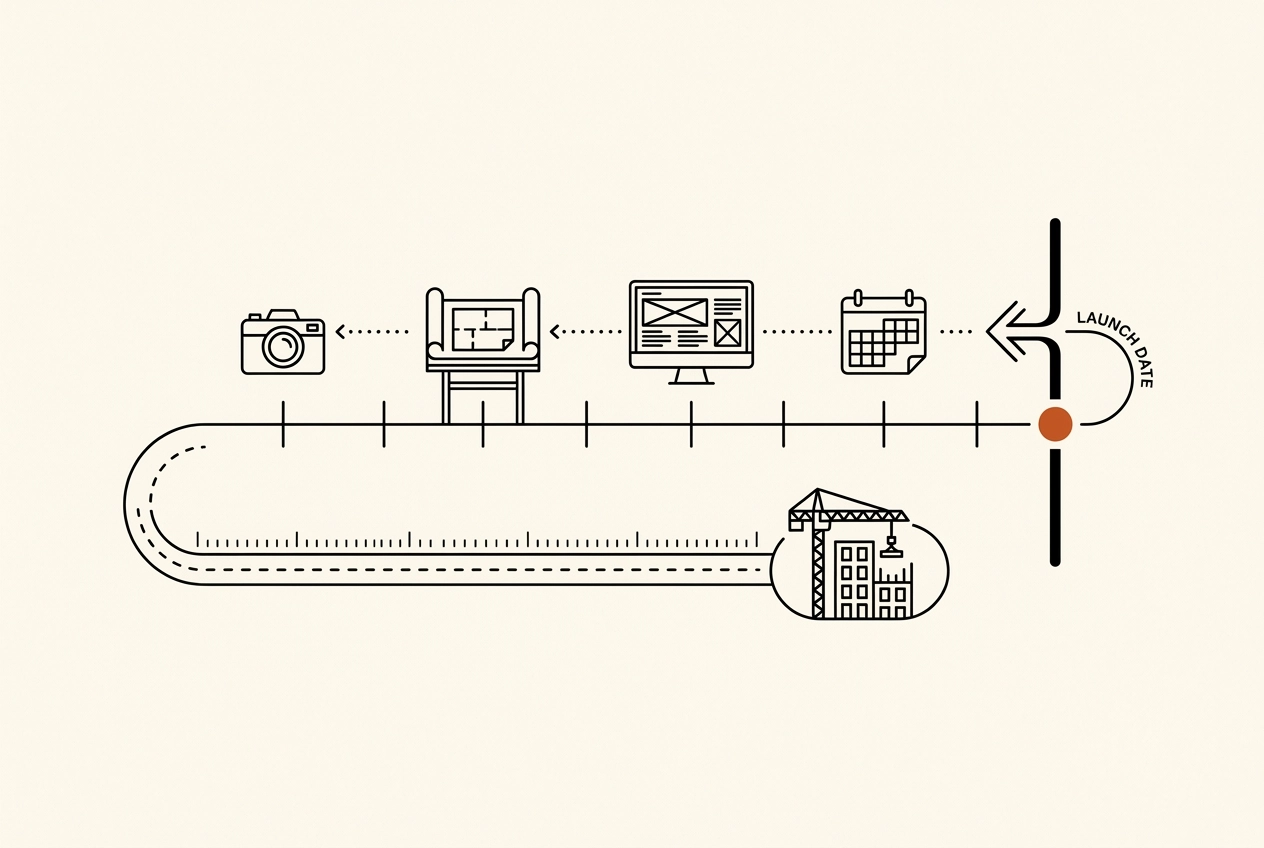
Every element of an off-the-plan campaign exists in relation to one date. Not the construction completion date. Not design documentation sign-off. The sales launch date. That date is the only fixed point from which a coherent marketing plan for property development can be built, and every production milestone should be reverse-scheduled against it with the same rigour applied to a construction programme.
These two timelines operate on fundamentally different logic, and conflating them is where most campaigns lose ground. Agents begin preparing their databases the moment a launch is announced; buyers begin forming impressions; the early registration window opens. That window is disproportionately valuable, and arriving at it with incomplete visualisations, an unfinished website, or a display suite still under construction breaks the momentum that a well-sequenced campaign spends months building.
Building a property marketing campaign backwards from the launch date reframes every commissioning decision. The question is no longer "when will design be resolved?" It becomes "what needs to be approved, produced, and delivered, and how far before launch does each process need to begin?" That inversion is the foundation of a campaign that actually lands.
What a Complete Asset Suite Actually Requires
Once the launch date is fixed and the reverse schedule is drawn, the next question is immediate and practical: what exactly needs to be produced, and how long does each piece genuinely take?
A credible off-the-plan campaign requires four distinct asset categories working in concert. Architectural visualisation and animation form the visual foundation; without resolved imagery, nothing else can be laid out, published, or displayed. Printed media covers the project brochure, floorplan packages, and display suite collateral. Digital assets include the project website, social content, and paid advertising creative. The display suite is a physical campaign asset in its own right, with a fabrication and installation schedule entirely independent of the others.
Each category carries its own lead time, and those lead times are almost always longer than developers expect. High-quality render production routinely extends beyond what most developers budget, scope and revision cycles alone can double an initial estimate. A project brochure, from brief to final print delivery, can consume many more weeks than developers expect once pre-press, proofing, and approval loops are accounted for. A properly built project website, with lead capture, CRM integration, and SEO groundwork, cannot be treated as a last-minute deliverable; the build, integration, and SEO groundwork each demand their own lead time. Display suite fitout, once joinery, signage, and installation are factored in, carries fabrication timelines that consistently exceed developer expectations.
The interdependency that catches most developers is this: visual identity must be resolved before any of these workstreams can begin in earnest. Renders briefed before the colour palette and typography are locked will need revision. Print laid out before the identity is confirmed gets reprinted. Digital assets built without a defined visual system look inconsistent at launch.
Wayfinding and external signage carry the same risk when left late. They are physical brand touchpoints, not construction accessories, and their fabrication timelines sit outside the print and digital schedules.
When workstreams are briefed to separate suppliers with no shared creative direction, the result is a campaign that looks assembled rather than considered. Buyers notice. Coordinating architectural visualisation, print, digital, and display suite fitout as integrated services under a single creative framework eliminates the translation losses that occur when multiple suppliers each interpret the same brief independently.
The Campaign Development Process Mapped Against Time
Knowing what you need to produce is one thing. Knowing when each piece must be in motion is another entirely.
Map the campaign backwards from your sales launch date and four distinct phases emerge, each with a non-negotiable start point. Based on our production experience across residential campaigns, a working phase structure looks like this:
Phase 1, foundation building (T minus 10 to 12 months). Project branding, visual identity, and creative direction must be resolved first, because everything downstream inherits from them. For large or complex projects, earlier is not excessive. This phase sets the palette, tone, and narrative that renders, print, and digital will all need to speak.
Phase 2, core asset production (T minus 6 to 8 months). Architectural visualisation, animation, website build, and printed media enter production once the creative foundation is locked. The lead times here are longer than most developers budget for, and this phase must accommodate meaningful iteration and client approval cycles, not a single-pass review. Understanding how this production process works is essential before commissioning begins.
Phase 3, pre-launch activation (T minus 8 to 12 weeks). Digital campaign infrastructure, CRM configuration, lead capture integration, and social content need to be operational well before the launch date, not assembled in the final days. Registrations should be flowing before the formal launch, not starting from zero on day one.
Phase 4, launch readiness (T minus 2 weeks minimum). Display suite fitout complete, print delivered, final digital assets deployed, and all systems checked. The two-week buffer is not contingency padding; it is the difference between a composed launch and a reactive one.
The phases developers most commonly miss: design iteration overruns that push branding past its deadline, consultant appointments made weeks too late, and a persistent underestimation of how long quality visualisation actually takes to produce. Each delay compresses every phase that follows it.
Architectural Visualisation: The Asset With the Longest Lead Time
Of all the production commitments in a property marketing campaign, architectural visualisation is the one developers most consistently underestimate. It looks like a deliverable. It feels like something you commission once design is resolved, wait a few weeks for, then receive. In practice, it is a multi-stage production process with compounding review cycles, and it almost always sits on the critical path.
The stages involved rarely get mapped out honestly at brief stage. Concept direction, camera angle selection, mood and materiality references, base modelling, lighting development, iterative review rounds, and final output preparation each carry their own time requirement. A single round of client feedback adds days. Design changes mid-production add more. Across a typical off-the-plan stills package, the realistic production window, when properly resourced and sequenced, is routinely measured in months rather than weeks, a scope most developers do not account for until they are already behind. Developers who budget only a few weeks find out why this matters at the worst possible moment.
Understanding what architectural visualisation actually contributes to a campaign also reframes when it needs to begin. Experienced studios do not wait for design to be fully resolved before opening a visualisation brief. Layered approval processes allow modelling to progress against schematic design while materials and finishes are locked in parallel, with staged sign-offs at each milestone. Knowing the right questions to ask when preparing a visualisation brief is what makes this possible without costly rework.
When renders arrive late, the damage is not contained. A website cannot publish its gallery. A brochure cannot be laid out without hero imagery. Display suite walls stay blank. Every downstream asset holds, and each week of render delay compresses the timelines of everything that follows.
Animation and walkthrough assets carry their own separate production schedule. They are not a quick extension of the stills package. Distinct modelling requirements, camera choreography, and render times mean they need to be briefed and scheduled as an independent workstream from the outset.
The quality of imagery at launch also carries a signal beyond the image itself. Buyers reading a development's ambition through its visualisations make fast judgements. Soft, unconvincing, or clearly provisional renders are read as a proxy for the project's overall quality. First impressions in off-the-plan sales are difficult to revise once set.
Printed Media and Display Suite Sequencing
Renders unlock everything downstream, but they do not cross the finish line alone. Once imagery is approved, a second production chain activates, carrying its own compounding delays that most campaign schedules do not account for.
Print is the clearest example. A perfect-bound project brochure takes approximately 15 days from proof approval to delivery, and that clock does not start until artwork is signed off. Add pre-press checks, colour proofing, and internal approval loops, and the gap between "renders approved" and "brochures in hand" routinely stretches to six or seven weeks. Developers who haven't mapped this chain discover it the week before launch.
The project brochure sits at the top of the printed asset hierarchy: the document a prospective buyer takes home and returns to. Below it sit floorplan packages, price lists, agent kits, and display suite collateral, each requiring its own brief, artwork phase, and print run. None can be templated from the brochure at the last minute without visible inconsistency.
The display suite deserves the same production rigour. It is a physical campaign asset, not a sales office fitted out when time permits. Joinery, printed wall panels, material samples, and branded touchpoints all have fabrication and installation lead times. The suite needs to be complete before the digital campaign generates its first registrations. A buyer who registers through a digital ad then arrives at a half-finished suite encounters a mismatch that quietly erodes confidence, defers decisions, and rarely self-corrects.
Wayfinding and external signage operate on a separate but parallel track. Design, council approvals where required, fabrication, and installation each carry independent lead times that do not compress easily. Our campaign work across residential and mixed-use projects has consistently shown that signage is briefed last and half-installed on launch day more than any other asset.
The breadth of disciplines we hold in-house exists to prevent these disconnects. When print, suite fitout, and signage are sequenced against the same launch date under one creative framework, the gaps close before they open.
Digital Assets, Website Readiness, and CRM Setup
The print and physical assets have a hard stop at delivery. The digital layer has no such forcing function, which is precisely why it gets treated as perpetually adjustable, and why it is almost always late.
The project website is not a marketing deliverable to be handed over at launch. It is a campaign asset with its own production timeline, and it needs to be live and actively collecting registrations weeks before the sales launch date. SEO equity accumulates over time. A site that goes live the day of the launch event has zero indexed authority, zero organic traction, and no registration history to show agents. The window for building that foundation is the pre-launch period, and it cannot be recovered once it has passed.
A launch-ready property website has specific requirements: mobile-optimised design that loads cleanly on the devices most buyers are actually using, integrated lead capture forms, render galleries that reflect the finalised visual identity, location-based SEO targeting the suburb and product type, and a construction progress section that keeps post-contract buyers engaged through the build. Each of these requires deliberate build time, not a weekend sprint before the launch event.
CRM configuration belongs in the same pre-launch window. Investor and owner-occupier buyers need different workflows from the moment they register. Setting up segmented automation in a system like ActiveCampaign after registrations have already started arriving means early leads receive generic communications, and that first impression is difficult to correct. The segmentation logic, automated sequences, and lead scoring thresholds should all be tested before the first form is submitted.
Registration form design also carries more strategic weight than most developers give it. Qualifying questions placed at first capture, positioned lightly and framed around genuine buyer intent, filter low-quality enquiries before they enter the pipeline. That requires considered form architecture, not a default template.
Each digital activation stage, SEO groundwork, organic content, paid media setup, email automation, should have a defined go-live milestone plotted against the sales launch date. Treated this way, the CRM data from a well-sequenced launch becomes genuinely useful for future projects: it tells you which buyer segments converted fastest, and which acquisition channels delivered the highest-quality leads.
Buyer Segmentation and Tailored Messaging From Day One
Segmenting your CRM workflows is only half the equation. The other half is ensuring the assets those workflows deliver are actually built for the audience receiving them.
Investors and owner-occupiers are not variants of the same buyer. They are making fundamentally different decisions, driven by different criteria, and they need to be spoken to accordingly from the first touchpoint. Investors represent roughly 30% of purchase activity, and that share is substantial enough to warrant a fully developed, parallel messaging framework, not a footnote in a brochure written for someone else.
Investor-oriented messaging centres on numbers and trajectory. Yield projections, rental demand context, vacancy rate data, infrastructure pipeline, and capital growth indicators are the relevant language. An ROI calculator embedded in the investor email sequence does more work than three pages of lifestyle copy. Location data framed around population growth and employment density speaks directly to the decision being made.
Owner-occupier-oriented messaging operates in a completely different register. Material palettes, ceiling heights, the proximity of a good primary school or weekend market, the quality of light in a north-facing living room. These buyers are visualising themselves in the space, and the assets need to facilitate that. Lifestyle imagery, detailed render selections, and amenity mapping carry the argument here.
The failure mode is predictable. Campaign assets produced without a clear buyer persona brief tend to hedge, including yield data alongside lifestyle imagery, writing copy that gestures at both audiences and connects with neither. The result is a campaign that feels unfocused, because it is.
Coherent creative direction is what prevents this from becoming two disconnected campaigns. A unified visual identity, applied consistently across segmented content, holds both messaging streams together. The investor and the owner-occupier encounter the same project, expressed through the same visual language, but spoken to directly.
What Late Commissioning Actually Costs
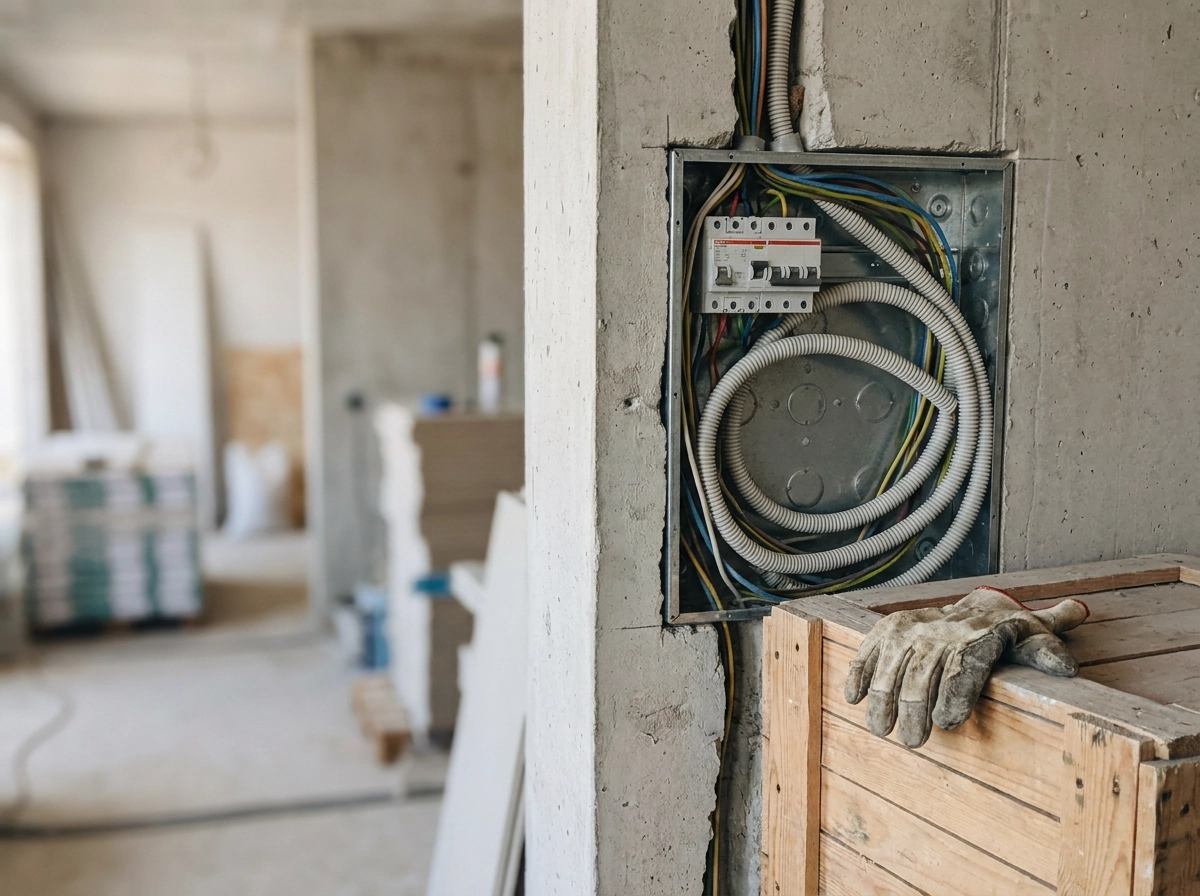
All of the above only matters if the assets are actually ready. The work of segmenting buyers and tailoring messaging is wasted if the campaign launches with half the materials missing.
Rework is where the real cost concentrates, and it is always time rather than money that cannot be recovered. Visualisations produced before branding is resolved get revisited. Brochures are reprinted after floorplan revisions. Websites are rebuilt after a creative direction pivot. Each of these events compresses the phases that follow, and they cluster precisely in the window where early registration momentum is either built or permanently forfeited.
Buyers who register early and then encounter placeholder renders, an incomplete brochure, or a display suite behind hoarding do not wait. They disengage quietly, often without explanation, and the re-engagement cost is high. In off-the-plan sales, the campaign is the product at the point of registration. An unfinished campaign communicates an unfinished project, and that signal is hard to walk back once set.
Front-loading asset investment costs less than a delayed or fragmented launch once rework, reprint, and lost conversion are accounted for honestly against the total campaign budget.
The reputational dimension is harder to quantify but no less real. A polished, coherent campaign signals to buyers, agents, and the broader market that the development itself is well-managed. Organisational competence is legible in the materials.
Coordinating Across Disciplines: The Case for a Holistic Approach
Much of the cost discussed in the previous section traces back to a structural problem that precedes the timeline: most off-the-plan campaigns are assembled from separate parts, briefed to separate suppliers, with no one holding the creative thread.
The multi-supplier model multiplies approval loops in ways that are easy to underestimate. Each discipline requires its own briefing round, its own review cycle, its own round of amends. Decisions made in one workstream are rarely communicated upstream or downstream in time to prevent rework elsewhere. The overhead compounds, and the campaign arrives at launch carrying the visible seams of a process that was never truly unified. No single supplier is at fault; each has interpreted the brief correctly within their own scope. The problem is that the brief was never truly shared, it was copied and forwarded, and something was lost in every translation.
The alternative is a studio that holds creative direction, visualisation, print, digital, and physical brand experience within a single integrated brief. When those disciplines share a creative framework from the outset, every asset speaks the same visual language because it was conceived and produced that way, not reconciled afterwards.
At Artegra, this is the foundation of how we approach architectural campaigns. From visualisation and interior styling through to display suite design, animation, wayfinding, signage, and digital, every touchpoint is built within one aligned creative framework. The story does not shift between channels. It compounds.
Building Your Reverse Schedule From Sales Launch Day
Once integrated production is structured under a single brief, the scheduling logic becomes straightforward: fix the sales launch date and work backwards.
That date is the only immovable point in the campaign. Every production milestone maps to it using realistic lead times, not aspirational ones.
The four phases described earlier map to these specific milestones. Based on our production experience across residential campaigns, a working reverse schedule looks like this:
T minus 10 to 12 months: Creative direction, project branding, and visual identity signed off
T minus 8 months: Visualisation modelling commenced, camera selections approved
T minus 6 months: Website in development, CRM configured, lead capture architecture briefed
T minus 10 weeks: Print artwork locked and submitted to pre-press
T minus 2 weeks: Display suite installation complete, all physical collateral on-site
These are not conservative estimates. They reflect what the work actually requires when client approvals, design iteration, and fabrication lead times are accounted for honestly.
Identifying the critical path means locating the one asset or approval that, if delayed, delays everything downstream. In most campaigns, that is the visual identity. Renders cannot be finalised without it. Print layouts depend on it. The website inherits it. If branding sign-off slips by three weeks, the compression is felt across every subsequent phase simultaneously.
Buffer time is not contingency thinking; it is structural discipline. Each phase should carry a defined buffer that absorbs overruns within that phase without borrowing time from the next. A three-week buffer in the visualisation phase protects print deadlines. A two-week buffer in the display suite installation schedule protects the launch event itself.
Alignment across the project team requires the campaign schedule to carry the same formal standing as the construction programme. The architect, development manager, sales agent, and marketing lead all need to sit within the same document, with shared milestones and clear accountability against each one. When the campaign timeline is treated as a marketing team concern rather than a project-wide commitment, approvals stall and no one is accountable for the delay.
Start With the Launch Date, Not the Design Lockdown

The argument running through this entire piece comes down to one disciplinary shift: the campaign schedule drives the design schedule, not the other way around.
Three actions change that immediately. Fix the sales launch date before design is resolved, not after. Commission a holistic campaign studio while the architecture is still in motion, so creative direction, visualisation, and brand can develop in parallel rather than in sequence. Then build a reverse production schedule using real lead times, not optimistic ones, treating every milestone with the same standing as anything on the construction programme.
Launching with front-loaded investment means launching with momentum: early registrations are stronger, agent confidence is higher, and the campaign holds together as a coherent body of work rather than a collection of assets that arrived at different times from different suppliers.
At Studio Artegra, we align creative direction, architectural visualisation, animation, printed media, digital assets, and display suite fitout into a single integrated production timeline, built backwards from your launch date. If your next project is approaching that critical window, this is the moment to start.
Conclusion
Timing is not a detail in off-the-plan campaigns; it is the architecture of the entire sales effort. The developers who succeed treat the launch date as sacred, commission creative work early, and build reverse schedules around real lead times rather than wishful ones. They understand that fragmented production does not just create inconsistent assets; it destroys early momentum that can never be fully recovered.
The core lessons are simple: fix your launch date first, commission holistically while design is still evolving, and treat every production milestone with the same discipline as your construction programme.
If your project is approaching that critical window, the time to act is now, not after design lockdown. Reach out to Studio Artegra to map your integrated campaign timeline and launch with the confidence, consistency, and momentum your project deserves.